970-989-2529
Bumps For Boomers
Ski For Life
ski for life

Book your Mogul Ski Lesson

Call 970-989-2529

Best Deals on Lodging

We Highly Recommend
Aspen Central Reservations

  • Aspen Staff With Local Knowledge
  • Largest Choice of Rooms
  • Discounts on Lodging and Airfare
  • Ask About Weekly Specials

Call Direct 800-456-0897
Or Book Online

FREE Mogul & Powder Skiing Tips

Weekly eMail
Great Techniques, No Spam

Bumps in the News

New York Times
Read what the New York Times
has to say about Bumps For Boomers,
Smoothing Bumps For Boomers.

National Public Radio
Listen to what National Public Radio
has to say about Bumps for Boomers,
Baby Boomers Desire Mountains.

How To Ski Moguls - Mogul Terrain Explained And Simplified

Print this pagePrint This Page

control | balance | tactics

How To Ski Moguls - Understand The Terrain Structure Of A Mogul Run

An understanding of mogul skiing terrain makes it much easier to learn how to ski moguls.

Moguls are formed by a succession of skiers turning at the same places on a run. The repeated paths, where turns are made, form troughs from skiers scraping off the snow. Where turns are not made, snow piles form which become the tops of moguls. Moguls typically start out with rounded tops but over time they tend to become elongated in a teardrop shape.

If you examine a wide range of mogul runs you will find a common set of terrain characteristics across all of them.

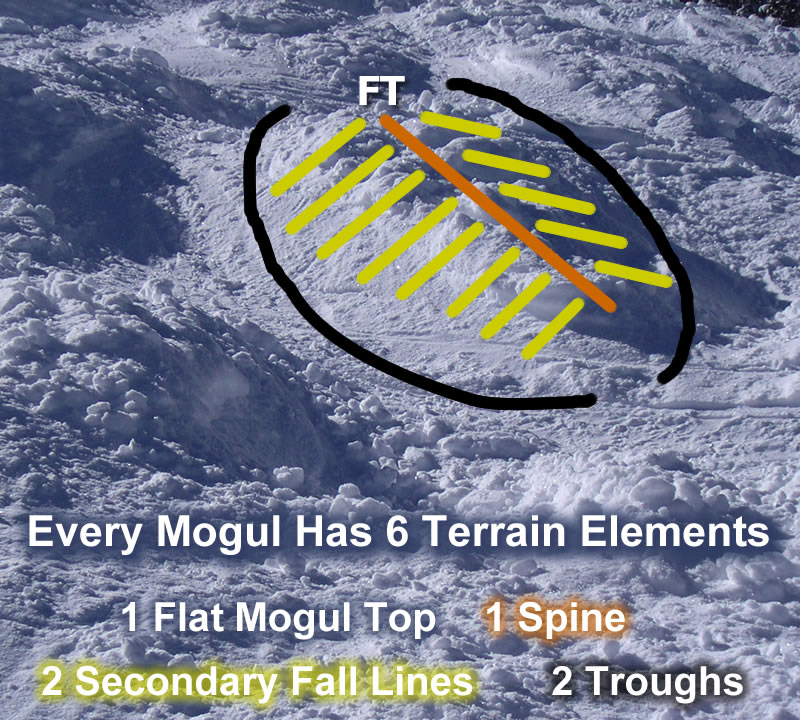
(1) Flat Top of Mogul: virtually every mogul has a top that is flat and the top is often covered with a soft pile of snow.

(2) Spine: nearly every mogul has a spine or pointed ridge line that runs from the top of the mogul to the bottom of the mogul.

(3) Secondary Fall Lines: on each side of every mogul spine there are angled slopes. Think of these slopes as secondary fall lines because the terrain slopes down at angles that are different from the overall fall line of the mogul run and different from the slope of the mogul spine. Each secondary fall line has its own unique slope angle and the slope angle typically varies across the length of the spine.

(4) Trough: troughs run between moguls and those troughs are at the base of the secondary fall lines that come off the mogul spines.

(5) Flat Top of Mogul Below: at, or near, the base (downhill end) of every mogul spine there is a flat top of another mogul, which is downhill from the mogul above it.

To better visualize these terrain characteristics, examine the two photos below. On the left you will see an aerial photo of a typical mogul. On the right you will see the same mogul annotated with the terrain elements discussed above.


Mogul runs are comprised of repeating patterns of the terrain elements shown above. To the uninitiated, however, this repeating terrain pattern often represents complexity, uncertainty, confusion and even fear. Particularly if your speed is accelerating and you have no idea of where to turn. Yikes!

 * * * * *

If you study mogul terrain, you realize that all moguls have flat tops (think of the flat top as a green run). And a mogul run consists on a series of flat tops, much like a staircase, which you can use to walk down the mountain. Even more to your advantage, the tops of most moguls have clumps of snow on them, which represent friction, which will slow you down. So lets recap:

Flat green run mogul tops with friction laid out in the form of a staircase going down the hill.

If you turn on the tops of the moguls, drift with a soft edge from one mogul top to the next, you can change the rules of the game.

Your best mogul technique for the least amount of speed: turn on the mogul tops and stay out of the troughs. Use this strategy turn a black or double-black mogul and powder run into a green run. It is a much more manageable, safe and fun experience.